
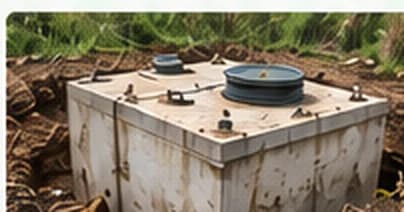
Tank vs. Field
Some symptoms suggest the tank; others suggest the field. Overlap is common. Both the tank and absorption area should be checked before either one is replaced.
Learn More
Homeowners often say “leach field.” Drain field and absorption field usually name the same part of the system: the area where effluent leaves the tank and soaks into the soil.
Sewage backup, wet ground, and outdoor odors can come from that area. They can also come from the tank, the distribution box, or the pipes between them. Field replacement is the right job only after the absorption area is shown to be what failed. Even then, the tank may still be usable.
The leach field (also called a drain field or absorption field) is where effluent disperses into the soil after leaving the septic tank and distribution components. Wet ground, surfacing wastewater, odors, and backups can occur when the absorption area is failing, but nearby piping or distribution problems can produce similar symptoms.
A tank problem, a distribution problem, or a plumbing issue closer to the house can look similar. Those possibilities have to be separated before anyone assumes the field must be replaced, or that the whole system must be replaced.
These situations can suggest a drain-field problem. They do not, by themselves, prove the field has failed:
Soil conditions and how the field is actually taking wastewater, not a symptom list, show whether the field has failed and what options remain.
Compare related failure areas so a leach-field problem is not confused with a tank or distribution problem.
Some symptoms suggest the tank; others suggest the field. Overlap is common. Both the tank and absorption area should be checked before either one is replaced.
Learn More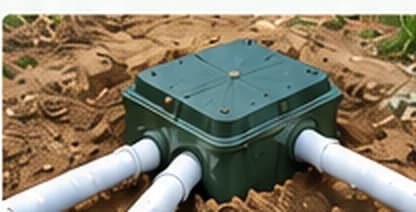
Limited distribution or piping problems can look like field trouble. Diagnosis should come before field replacement assumptions.
Learn More
If the tank and field have both failed, or the lot leaves little room for a partial approach, replacement of the whole system may be the project.
Learn MoreLimited space, soils, or other constraints can change how a replacement absorption area must be designed. The replacement design depends on the conditions documented for that property.
Learn MoreNot necessarily. In some situations, an absorption area can be replaced while a sound tank and other components remain in service, subject to the design and the required approvals.
In other situations, field failure coincides with tank deterioration, distribution failure, or site conditions that make a partial approach unrealistic. Those are different outcomes from different facts.
Before replacing an absorption area, determine:
For how this fits a larger replacement, see septic system replacement. For a limited component problem first, see septic system repair.
Major leach-field replacement generally follows evaluation and design before construction. Exact requirements vary by project and location.
Separate absorption-area problems from tank, distribution, or plumbing issues before treating field replacement as the job.
A replacement field depends on remaining usable area and how the site can treat wastewater—not only on the location of the old trenches.
Design must account for soil, space, and applicable requirements. Some sites need an engineered design. That is not required on every lot.
County review and approval are typically part of major septic work. Additional review may apply depending on location.
Construction proceeds according to the approved design, including how the field reconnects to the rest of the system.
Where required, inspection may occur before burial. Final steps depend on the approved plan and site conditions.
When leach-field replacement is part of addressing a failing septic system, some Schoharie County homeowners may be able to look into CWC or the New York State replacement fund. Eligibility depends on the property and current program rules.
Repair and replacement help for qualifying homes in eligible West-of-Hudson watershed areas. In Schoharie County, CWC identifies Broome, Conesville, Gilboa, and Jefferson.
Learn MoreSchoharie County participates and takes applications. The fund applies to properties that meet the priority-waterbody rules.
Learn MoreA deteriorated tank can be replaced without replacing a functioning field, and a failed field will not be cured by tank work alone. Check both before choosing the work. Read about septic tank replacement.
CWC assistance and the New York State replacement fund may apply to qualifying replacement work. Awards are not automatic. Explore septic replacement funding.
Limited space, soils, slopes, or groundwater constraints can change how a replacement absorption area must be designed. Learn about engineered septic systems.
A leach field—also called a drain field or absorption field—is the part of a septic system where effluent disperses into the soil after leaving the tank and distribution components. Different names usually describe the same functional area.
Wet or saturated areas, surfacing wastewater, odors near the field, recurring problems, or inspection findings can suggest absorption-area trouble. Those signs do not prove the field has failed. The soil and the field itself still have to be checked.
Not always. Sometimes the absorption area is the primary failure and other components remain serviceable. Sometimes multiple parts have failed, or site conditions require a broader project. That distinction is property-specific.
Limited distribution or piping problems are sometimes mistaken for field failure. True absorption-area failure often leads to replacement of that area rather than a small patch. Whether any repair approach is adequate depends on evaluation and applicable requirements.
No. Tank replacement addresses tank condition. It does not restore a failed absorption area.
Qualifying replacement work may be eligible for assistance under the CWC or New York State programs. Eligibility depends on the property and current program requirements.
Confirm what failed before assuming the entire septic system must be replaced.