
Catskill Watershed Corporation
Repair and replacement help for qualifying homes in eligible West-of-Hudson watershed areas. In Schoharie County, CWC identifies Broome, Conesville, Gilboa, and Jefferson.
CWC septic program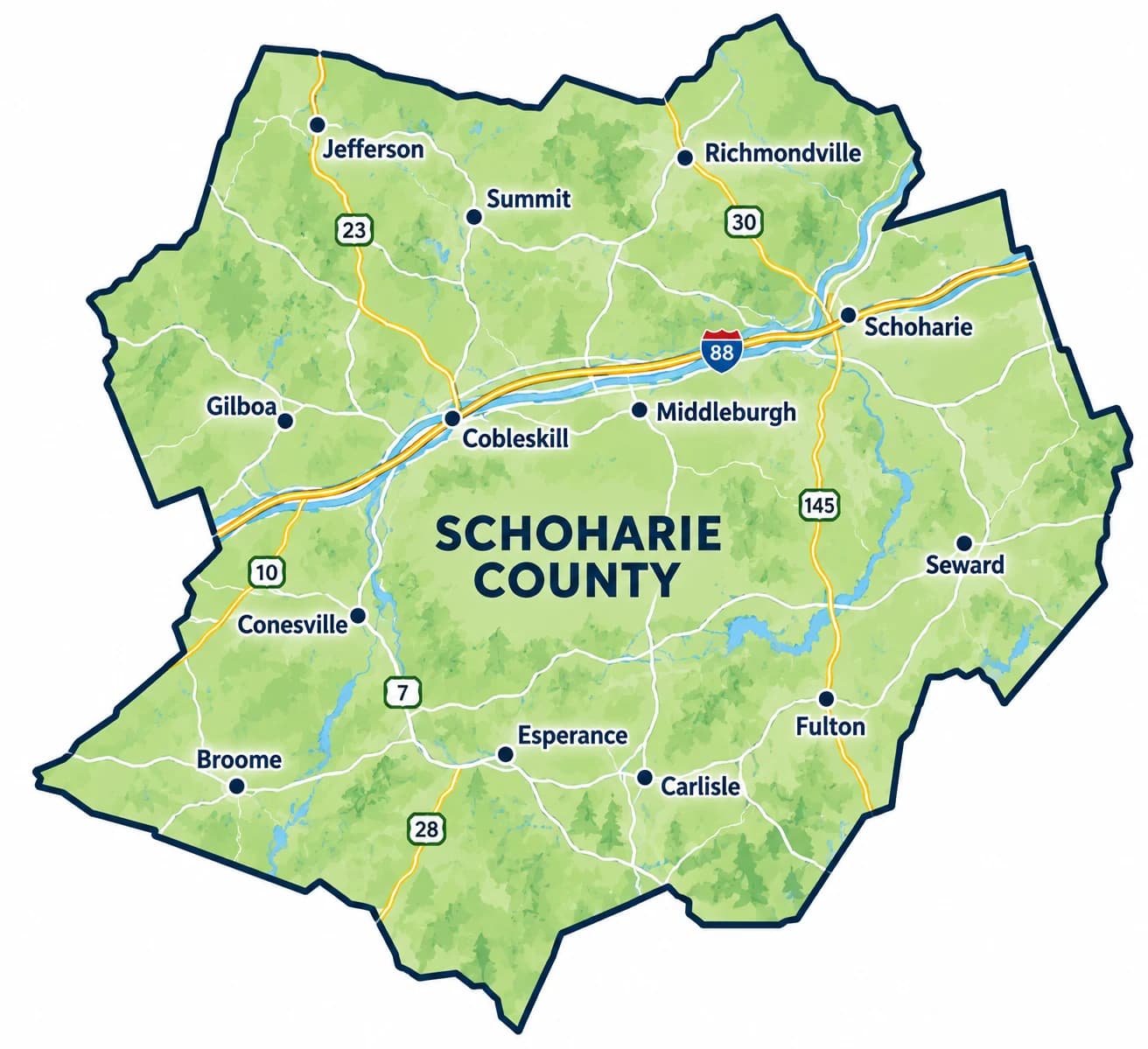
A septic backup, a wet yard, or a failed inspection in Schoharie County still starts with the same fact: something failed, and the symptom does not name the part.
Major repair and replacement may require site evaluation, design, and approval. Qualifying properties may also be eligible for CWC or New York State replacement assistance.
Sewage in the house, slow drains, outdoor odors, or wet ground over the yard can come from the tank, the distribution box, the pipes, or the absorption area. One of those findings can support a component repair. Several of them, or an absorption area that can no longer accept effluent, can mean replacement of one area or of the whole system. The inspection findings should show whether the problem is limited to one component or affects enough of the system to require broader replacement.
Major work in Schoharie County commonly moves from that evaluation into soil and site work where required, a design prepared by an appropriately licensed design professional, county review, installation, and inspection where the approval requires it. Properties in portions of the New York City watershed may have an additional review. That extra step depends on the property, not on the county name alone.
Cobleskill, Middleburgh, Schoharie, Richmondville, Gilboa, Conesville, Jefferson, Broome, Esperance, Carlisle, Fulton, Seward, and Summit.
The same system parts can fail throughout the county. CWC currently lists Broome, Conesville, Gilboa, and Jefferson as its Schoharie County program towns, with eligibility also depending on the property and current program requirements. The New York State Septic System Replacement Fund uses separate priority-waterbody and eligibility rules.
Two published programs can apply. Awards are not automatic. The program administrator decides under current rules.
Repair and replacement help for qualifying homes in eligible West-of-Hudson watershed areas. In Schoharie County, CWC identifies Broome, Conesville, Gilboa, and Jefferson.
CWC septic programSchoharie County participates and takes the applications. The fund applies to properties that meet the priority-waterbody rules.
NYS replacement fundOfficial program resource
Start With the Official CWC Septic Program Inquiry →Official Catskill Watershed Corporation program page.
Official program resource
Open the Official NYS EFC Septic Replacement Page →Official New York State Environmental Facilities Corporation resource.
Eligibility is determined by the program administrator under current program rules. For the county funding overview, see septic replacement funding.
A backup or a wet yard does not name the failed component. These pages explain how tank, drain-field, and multi-component failures differ:
Cobleskill, Middleburgh, Schoharie, Richmondville, Gilboa, Conesville, Jefferson, Broome, Esperance, Carlisle, Fulton, Seward, and Summit. The same tank, distribution, and absorption-area problems can occur throughout the county. Funding eligibility, however, depends on the individual property and current program rules.
Current CWC septic program materials identify Broome, Conesville, Gilboa, and Jefferson among Schoharie County program towns. A town listing does not mean every property qualifies. Watershed location and other current program criteria still apply.
Pumping removes wastewater and accumulated solids from the tank. It can relieve an overfull tank for a time. It does not repair a cracked tank, damaged distribution components, or an absorption area that can no longer accept effluent.
Call with what you are seeing, or send the inspection findings and a short history of backups and pumping.