
NYS Septic System Replacement Fund
The state fund may apply if the property meets the priority-waterbody and other current eligibility requirements. A matching town or creek name is not enough.
NYS Septic System Replacement Fund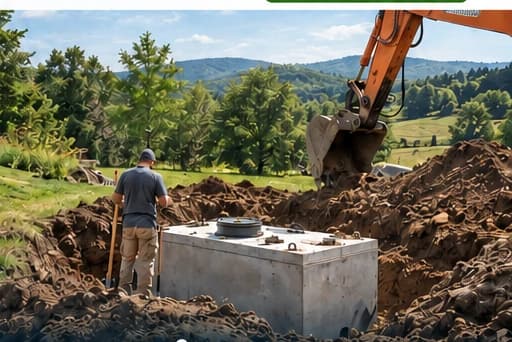
A backup that returns after the tank is pumped, a wet area in the yard, or an inspection that fails during a sale all leave the same gap: the symptom is known, and the failed part is not.
In Cobleskill, the next work is to separate the tank, the distribution components, and the absorption area before anyone prices a complete replacement.
Sewage in a tub, a slow kitchen line, or an odor near the foundation can start in the house plumbing. The same signs can start in a tank that no longer holds or passes wastewater, in a distribution box that no longer splits flow, or in an absorption area that has stopped accepting effluent. None of those signs names the part by itself.
Cobleskill is not among the Schoharie County towns currently identified for the CWC septic program. CWC currently lists Broome, Conesville, Gilboa, and Jefferson as its Schoharie County program towns. For a Cobleskill property, the New York State Septic System Replacement Fund is the relevant funding program to check when the property may meet the priority-waterbody and other current eligibility requirements.
Official New York State Septic System Replacement Fund materials list Cobleskill Reservoirs and Cobleskill Creek Tributary among Schoharie County priority-waterbody areas. Those names do not make every Cobleskill property eligible. The fund looks at the property’s relationship to a designated waterbody, plus the other current program rules.
A structurally damaged tank can be replaced while a working absorption area stays in service, if evaluation supports that split. The reverse is also true: a field that is saturated or surfacing effluent will not be cured by a new tank. Distribution piping can imitate either problem when a line is crushed, disconnected, or no longer carrying flow to the trenches.
Pumping removes wastewater and accumulated solids. It can lower the liquid level for a while. If the level returns quickly, or sewage backs up again, another pump-out has not identified whether the tank, the outlet, or the field is the limit. Repeated pumping should not stand in for that diagnosis.
Component repair remains possible when the failed item is limited—a distribution box, a run of pipe, an inlet or outlet fitting—and the rest of the system can still meet the applicable requirements. Partial replacement is the middle case: renew the tank or the absorption area and leave the sound portion. Complete replacement is the case when several major parts have failed, or the site can no longer support the old layout.
When the failed part is still unclear, compare tank and drain-field failure. Repair versus replacement separates a repair of one component, replacement of one major component, and complete system replacement.
A failed inspection during a sale gives the buyer and seller a written finding, not a construction plan. The useful document is the one that says which component failed and how the inspector saw it: structural damage, a hydraulic problem, a distribution failure, or an absorption-area condition. “System failed” without that detail still has to be unpacked.
Timing pressure does not change the sequence. Evaluation, soil work where it is required, design, and county approval come before installation. If replacement of a failing system may qualify under the state fund, the program’s current timing rules should be checked before design and construction are locked. See what happens after a failed septic inspection.
The NYS Septic System Replacement Fund may apply when a Cobleskill property meets the priority-waterbody and other current eligibility requirements. Cobleskill Reservoirs and Cobleskill Creek Tributary appear in current Schoharie County listings. A street address in Cobleskill is not the same thing as a verified relationship to either listing.
Qualifying properties in eligible priority-waterbody areas may want to investigate the program administered by Schoharie County for the state fund. The county contact and application are on the state-fund page.
CWC remains a separate program. It currently identifies Broome, Conesville, Gilboa, and Jefferson among Schoharie County program towns, not Cobleskill.
The state fund may apply if the property meets the priority-waterbody and other current eligibility requirements. A matching town or creek name is not enough.
NYS Septic System Replacement FundHow the New York State replacement fund and the Catskill Watershed program differ.
Septic replacement fundingOfficial program resource
Open the Official NYS EFC Septic Replacement Page →Official New York State Environmental Facilities Corporation resource.
Eligibility is determined by the program administrator under current program rules.
Major septic work in Schoharie County commonly follows evaluation, design, and required review. The property, not the town name, sets the details.
Tank, absorption area, distribution components, or more than one of those. The symptom list is not that identification.
Existing components, remaining space, and soil evaluation where it is required.
Plans are commonly prepared by an appropriately licensed design professional.
County review is typically part of major septic work. Watershed review applies only where the property is subject to those requirements.
Construction follows the approved plan, including any inspection before components are covered.
Richmondville, Carlisle, and Middleburgh.
No. Current CWC materials identify Broome, Conesville, Gilboa, and Jefferson among Schoharie County program towns. A Cobleskill address is not a reason to assume CWC coverage.
No. Those names appear among Schoharie County priority-waterbody listings. Eligibility still depends on the property’s location relative to the designated area and on the other current program rules.
Not by itself. Wet ground can involve the absorption area, distribution piping, surface water, or more than one of those. The tank’s condition is a separate finding.
The inspection report if there is one, any older system records, where the tank and absorption area are if you know, and a short history of backups, pumping, odors, and wet ground.
Call with the symptom and any inspection findings. The failed component still has to be confirmed on the property.