

Tank vs. Drain Field
Tank and absorption-area problems can produce some of the same symptoms, so both parts should be considered before replacing either one.
Learn More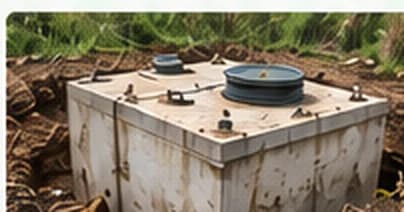
A sewage backup can have several causes. A failed tank is only one of them.
A tank can fail structurally even when the absorption area remains usable. Sewage backup or slow drainage can also occur when the tank is intact but wastewater cannot move through the rest of the system. The failed component should be identified before deciding what needs to be replaced.
The septic tank separates solids and begins wastewater treatment before effluent moves toward the absorption area. A structurally failed tank may need replacement even when the absorption area is still functioning.
Age can be useful context. Age alone does not prove a tank must be replaced. Likewise, replacing a tank will not fix a failed drain field.
Tank condition has to be confirmed on the property. Age, a single symptom, or a neighbor’s experience is not a substitute for that evaluation.
These situations can justify a closer look at the tank. They do not prove that the tank must be replaced:
The tank's condition shows whether it is the main problem, part of the problem, or still sound.
Tank replacement makes sense only when the tank itself has failed and the condition of the remaining system is understood.
Tank and absorption-area problems can produce some of the same symptoms, so both parts should be considered before replacing either one.
Learn More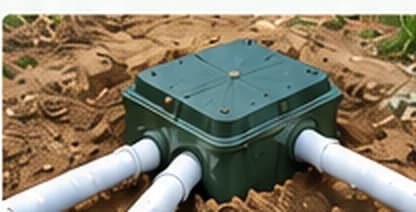
A damaged baffle, inlet, outlet, or connecting pipe may be repairable without replacing the tank. Structural tank failure is a different problem.
Learn MoreIf the field has failed, tank replacement alone will not solve the problem. If the field is still accepting wastewater, replacing only the tank may be enough.
Learn More
If both the tank and absorption area have failed, replacement may involve the complete system. Site conditions can also affect the design of the replacement.
Learn MoreNot every tank-related issue requires a new tank. Not every new tank project is “just drop in a tank.” The tank must reconnect to the remaining system under an approach that fits site conditions and applicable requirements.
Before replacing the tank, determine:
Major tank work may also require site review, design, and approval. A limited baffle, inlet, outlet, or connection problem may be repairable without replacing the tank.
Before a tank is replaced, the condition of the connecting pipes, distribution components, and absorption area should also be considered.
Confirm whether symptoms and findings point to the tank, the field, distribution components, or more than one area.
A new tank connected to a failed absorption area does not create a working septic system.
Limited component issues may differ from full tank replacement. That distinction is property-specific.
Major septic work commonly involves plans and review. Exact requirements depend on the project and location.
The replacement tank must be set and connected according to the approved approach and site conditions.
Where required, inspection may occur before burial. Final steps depend on the approved plan.
When tank replacement is part of addressing a failing septic system, some Schoharie County homeowners may be able to look into CWC or the New York State replacement fund. Eligibility depends on the property and current program rules.
Repair and replacement help for qualifying homes in eligible West-of-Hudson watershed areas. In Schoharie County, CWC identifies Broome, Conesville, Gilboa, and Jefferson.
Learn MoreSchoharie County participates and takes applications. The fund applies to properties that meet the priority-waterbody rules.
Learn MoreTank and field failures can present overlapping symptoms. Confirming which area failed is more useful than ordering work based on the most expensive assumption. Compare tank and drain-field failure.
Some problems around the tank are limited to a baffle, a pipe, or a connection. Others mean the tank itself has to be replaced. Naming which one it is can keep a working field from being rebuilt at the same time. Read about septic system repair.
Assistance may apply to qualifying replacement work under current program rules. Check current eligibility. Do not assume approval. Explore septic replacement funding.
Structural damage, inspection findings, deteriorated components, or evaluation that shows the tank cannot remain in service can point toward replacement. An older tank does not need replacement solely because of its age. Structural condition, leakage, deterioration, and inspection findings are more important.
No. Age can be useful context, but an older tank should be judged by its condition and how it is performing, not by the year it was installed.
No. Tank replacement addresses the tank. A failed absorption area requires its own evaluation and, when needed, field replacement or a broader system approach.
Sometimes limited component or connection issues can be addressed without a full tank replacement. Structural failure or other major tank defects often lead to replacement. That determination is property-specific.
Not necessarily. If the absorption area and other components remain serviceable, tank replacement may be the appropriate category of work. If multiple areas have failed, a larger project may be needed.
The tank must be properly connected to the remaining system, and any required inspections or completion steps must be satisfied. Exact steps depend on the approved plan and site conditions.
Separate the tank's condition from the drain field's condition before choosing the work.