
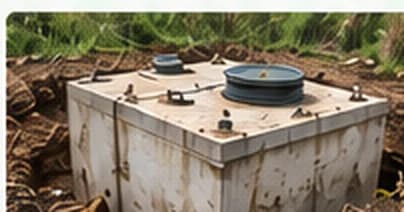
Septic Tank
A damaged or deteriorated tank may be replaceable on its own—or may signal that more of the system needs attention.
Learn More
When a septic system is failing, determine whether the problem is in the tank, distribution components, absorption area, or more than one part of the system. Complete replacement is not necessary when a failed component can be repaired or replaced while the rest of the system remains usable.
Complete replacement is the scope when more than one major part of the system has failed, or when the remaining parts cannot support a smaller repair. If evaluation shows that only the tank needs replacement and the rest of the system may still be serviceable, see septic tank replacement.
Backups, odors, and wet ground are reasons to investigate. They do not prove that the entire system must be replaced. The failed component has to be identified first.
Potential failure areas include:
Determining what failed comes before deciding how much must be replaced. A failed tank can require different work from a failed absorption area, and the same symptom can occur with either problem.
For a closer comparison, see repair versus replacement and tank versus drain-field failure. Inspection of the tank, distribution components, and absorption area should identify where the failure is occurring.
These situations can indicate a septic problem that deserves evaluation. They may point toward repair, partial replacement, or full replacement—or toward a different issue entirely.
A symptom can suggest a problem. It does not, by itself, prove that a new system is required.
The failed component determines whether the work involves a repair, replacement of one major component, or replacement of the complete system.
A damaged or deteriorated tank may be replaceable on its own—or may signal that more of the system needs attention.
Learn More
Drain-field failure can drive a larger replacement decision, especially when soil saturation or surfacing wastewater is present.
Learn More
Problems in the distribution box, piping, or related components may be limited—or may point to broader system issues.
Learn More
When multiple parts have failed, or site conditions leave little room for a partial fix, full replacement may need evaluation.
Learn MoreA limited component failure may be repairable. Failure affecting the tank, absorption area, or several major components may require replacement.
Whether repair is practical depends on:
Major septic replacement work generally follows a sequence of evaluation, design, and approval before construction. Exact requirements vary by project and location.
Clarify symptoms and which part of the system may be involved before assuming full replacement.
A property-specific look at existing components, site constraints, and conditions that affect options.
Soil evaluation may be needed so a design can account for how the site can treat wastewater.
In Schoharie County, septic designs are commonly prepared by an appropriately licensed design professional.
County review and approval are typically part of major septic work. Properties in the NYC watershed may involve additional review.
Work proceeds according to the approved design and applicable construction requirements.
Where required, inspection may occur before components are covered.
Final steps depend on the approved plan, inspections, and site conditions.
Depending on property location and current program rules, some Schoharie County homeowners may be able to investigate financial-assistance programs related to septic replacement. Eligibility is never automatic.
Repair and replacement help for qualifying homes in eligible West-of-Hudson watershed areas. In Schoharie County, CWC identifies Broome, Conesville, Gilboa, and Jefferson.
Learn MoreSchoharie County participates and takes applications. The fund applies to properties that meet the priority-waterbody rules.
Learn MoreSite conditions can affect how a system must be designed. Considerations may include soil conditions, available space, slopes and topography, groundwater or other site constraints, and applicable design requirements.
An engineered system should be specified only after the property’s site and soil conditions have been evaluated. Learn about engineered septic systems.
A failed septic inspection—especially during a property transaction—raises practical questions: what failed, how severe it is, whether repair is realistic, whether replacement is needed, what design and approvals may follow, whether a funding program may apply, and how timing may affect a sale. Read about failed septic inspection.
Major septic work in Schoharie County commonly goes through evaluation, design, and county review before construction. Watershed review and funding rules can differ by property. Service areas include Cobleskill, Middleburgh, Richmondville, Gilboa, Conesville, Jefferson, and Broome.
Not always. Symptoms can come from the tank, the drain field, distribution components, or a combination. Identifying what failed shows whether a repair, replacement of one area, or replacement of the whole system is required.
Sometimes. It depends on which component failed, the condition of the rest of the system, site and soil conditions, design requirements, and whether a repair can adequately address the problem under applicable approvals. That decision is property-specific.
Tank and drain-field problems can produce overlapping symptoms. Inspection of the tank, outlet, distribution components, and absorption area can show where the failure is occurring.
A failed inspection raises questions about what failed, how serious it is, whether repair is realistic, whether replacement is needed, and how design, approvals, funding, and any property transaction may be affected. The report does not pick one outcome by itself.
Major septic work in Schoharie County often involves plans prepared by an appropriately licensed design professional, followed by required review and approval. Exact requirements depend on the project and location.
Some Schoharie County homeowners may be able to look into CWC or the New York State replacement fund. Eligibility depends on the property and current program rules.
Timing varies. Evaluation, design, approvals, site conditions, contractor scheduling, and project scope all affect the calendar. There is no single fixed duration that fits every property.
Start by identifying the problem and understanding your options.